
Referrals Are a Gift, Not a Strategy
Why every business needs a predictable marketing system — and why word-of-mouth alone was never built to carry the weight of consistent growth.
Marketing Philosophy · Business Growth · 12 min read
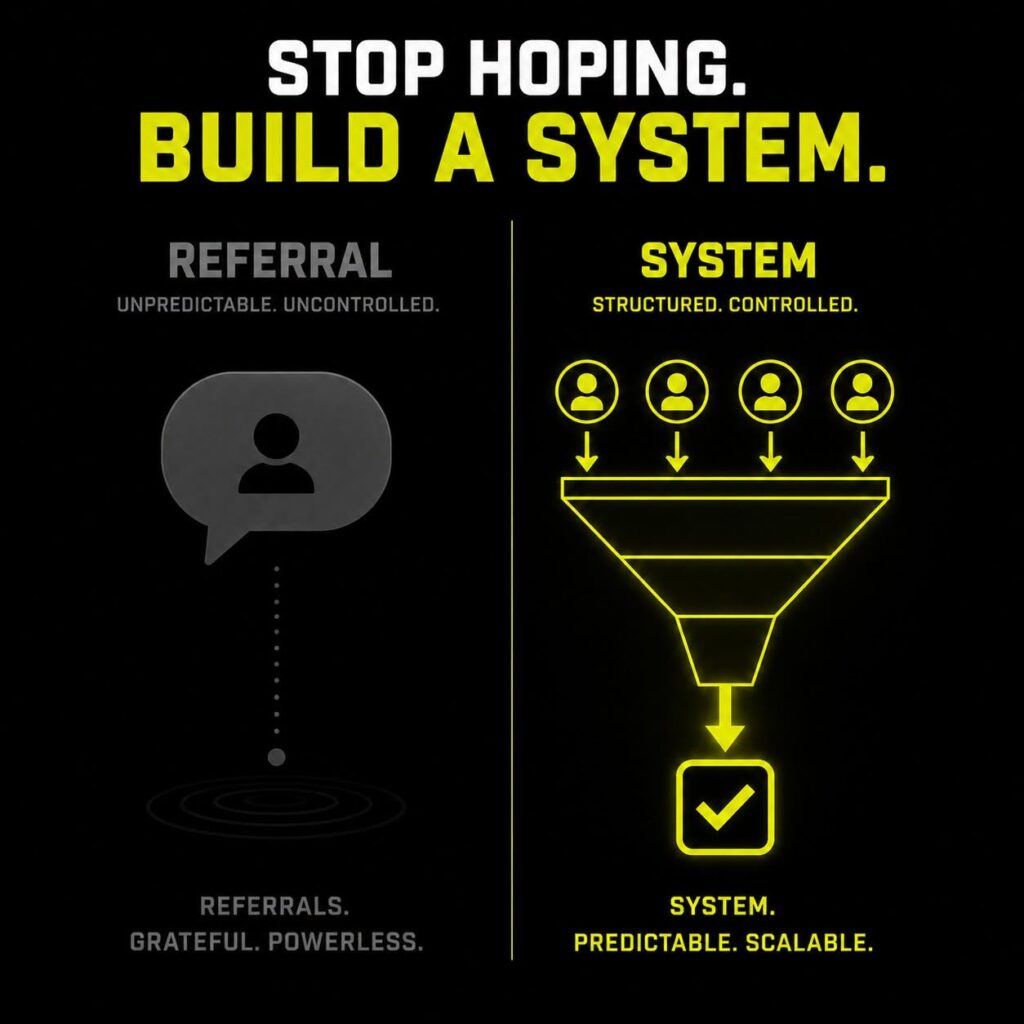
There is a specific type of business owner I want to speak to. Not the one just getting started, and not the one still trying to figure out if people even want what they sell. I’m talking to the business owner who already knows they’re good at what they do. You’ve served clients, delivered results, and people have thanked you. Some clients come back. Others tell their friends about you. You have proof that your business works.
Yet every now and then, something happens that quietly keeps you awake at night. The inquiries stop. One month you’re turning people away because you’re busy; the next month your phone barely rings. Your inbox is unusually quiet. You start refreshing WhatsApp, checking your email, watching Instagram notifications — waiting, wondering where the next client will come from.
Nothing has changed about your service. Your work is still excellent. Your reputation hasn’t disappeared. But business has slowed down, and you have no clear explanation why.
If this sounds familiar, you’re not alone. Thousands of service businesses find themselves trapped in exactly this position. From outside, everything looks successful. Inside, revenue depends on hope — hope that a previous client recommends you, hope that someone remembers your name, hope that the phone rings tomorrow. That isn’t a growth strategy. It’s a waiting strategy. And waiting has never built a great business.
The Comfort—and Danger—of Referrals
Before we go any further, let’s make something clear: there is absolutely nothing wrong with referrals. In fact, referrals are one of the best sources of new business any company can receive. When someone recommends your business to another person, trust transfers. Instead of introducing yourself to a complete stranger, you’re speaking to someone who already believes you’re credible because someone they trust has already vouched for you.
That changes everything. The conversation becomes easier. Price objections become smaller. Closing the sale often becomes faster. Referral leads typically convert better than cold leads because much of the trust-building process has already happened before the first conversation even begins.
This is why every business should strive to create experiences worth talking about. Satisfied customers naturally become advocates, and great work deserves recommendations. So this article isn’t about replacing referrals — it’s about understanding their limitations. Because while referrals are incredibly valuable, they are also incredibly unpredictable.
The Difference Between an Asset and a Strategy
Many business owners accidentally confuse an asset with a strategy. A referral is an asset. A strategy is something entirely different — it’s repeatable, measurable, and it can be improved and scaled. Most importantly, it’s under your control.
Think about your electricity. If your entire office depended on sunlight coming through the window, you might get enough light some days. Other days, clouds would appear, rain would come, night would fall. You wouldn’t call sunlight your electrical strategy — you’d install a power system because you need something reliable.
Referrals are exactly like sunlight: wonderful when they’re available, unreliable when they’re not. A marketing system is the generator. It works because you built it to work. The difference isn’t that one is good and the other is bad — the difference is control. Businesses grow when they control the activities that produce customers. They struggle when customer acquisition depends on chance.
Why Referrals Feel Like a Strategy
So why do so many businesses rely almost entirely on referrals? Because referrals create an illusion of stability. You finish a project, the client is thrilled, and a week later they recommend two new customers. Those customers become paying clients, and one of them refers another person. Now business is growing, and it’s easy to conclude: “My business grows through referrals.” And for a while, that’s true — until one month, nobody refers anyone.
Not because people stopped liking your work. Not because your service declined or your reputation disappeared. Simply because life happened: a former client changed jobs, another got busy, someone forgot, someone else assumed you’d already have enough work.
This is one of the biggest misconceptions in business growth. People assume referrals stop because satisfaction decreases. Often they stop because referrals were never something you controlled in the first place. Your clients have lives, families, deadlines, and pressures of their own — you are not the center of their attention. People refer businesses when circumstances happen to create the opportunity, not when your revenue requires it. Those two timelines almost never align.
The Invisible Risk Most Business Owners Ignore
There’s another problem with referral-dependent businesses that isn’t discussed enough: the risk is invisible. Unlike declining sales, poor reviews, or rising expenses, referral dependency doesn’t feel dangerous until it’s already hurting your cash flow. Everything seems fine — then suddenly revenue slows, the pipeline dries up, and stress increases.
Now you’re trying to generate clients from a position of urgency, and urgency is one of the worst positions from which to market, because desperate businesses make desperate decisions. They post constantly on social media, discount prices, chase trends, copy competitors, and boost random posts — doing everything except building an actual customer acquisition system. Ironically, this makes the problem worse, because activity is not the same thing as strategy.
Hope Is Not a Marketing Plan
If I asked you, “How many qualified leads will your business receive next month?” — could you answer confidently? Not approximately. Not hopefully. Confidently. Most business owners can’t. Their answer usually sounds something like: “We’ll see.” “I hope things pick up.” “It depends.” “We usually get referrals.”
Those answers reveal something important: they don’t actually have a lead generation system, they have optimism. Optimism is important, but optimism doesn’t pay salaries, cover rent, help you hire confidently, or let you forecast revenue.
Businesses aren’t built on optimism. They’re built on systems.
A restaurant doesn’t hope ingredients appear. A manufacturer doesn’t hope raw materials arrive. An airline doesn’t hope airplanes fuel themselves. Every serious business creates systems around the things it cannot afford to leave to chance. Customer acquisition deserves exactly the same treatment.
What Predictable Businesses Understand
Take a look at businesses that continue growing year after year. Whether they’re small local companies or global brands, they all share one common characteristic: they don’t wait to be discovered. They deliberately create opportunities to be found.
This doesn’t necessarily mean spending millions on advertising. It means having intentional systems. They know who their ideal customer is, where that customer spends time, what problems that customer is trying to solve, what message captures attention, what builds trust, and what moves someone from awareness to inquiry. Nothing is accidental. Every step is designed — which is why predictable businesses can estimate growth, not perfectly, but with far greater confidence than businesses relying entirely on word-of-mouth.
Marketing Is Not Posting
One of the biggest misunderstandings today is the belief that marketing simply means posting on social media. It doesn’t. Posting is an activity. Marketing is a system, and there’s an enormous difference.
A business owner might post every day for six months — beautiful graphics, professional videos, inspirational captions — yet receive almost no qualified inquiries. Meanwhile another business posts less frequently but consistently attracts new clients. Why? Because visibility alone isn’t enough. The right people must see the right message at the right stage of their buying journey. That’s strategy. Marketing isn’t about creating more content — it’s about creating more customers. Content is one tool inside a much larger system. Without strategy, content becomes noise.
Visibility Without Positioning Creates Confusion
Many businesses believe they have a lead problem. Often, they actually have a positioning problem. Imagine walking into a crowded marketplace. One person says, “I sell marketing.” Another says, “I help service businesses build predictable customer acquisition systems using Meta advertising and strategic positioning.” Which one sounds clearer? Which feels more specialized? Which seems easier to trust?
People don’t buy the most talented business — they buy the business they understand most quickly. Clarity reduces uncertainty, and uncertainty reduces sales. Positioning isn’t about sounding clever; it’s about becoming memorable. Without positioning, even excellent marketing becomes expensive because you’re constantly explaining yourself. With positioning, every advertisement works harder, every referral becomes stronger, and every conversation starts from clarity instead of confusion.
The Cost of Being Invisible
Many business owners underestimate the financial cost of invisibility. They think the only expense they’re avoiding is advertising — but there’s another cost they pay every single day: the cost of opportunities that never find them.
Every day someone searches for exactly what you offer, asks for recommendations, compares providers, and decides who to contact. Someone hires your competitor — not because your competitor is better, but because they were easier to find. Visibility isn’t vanity. Visibility is access. If people don’t know you exist, they cannot buy from you, no matter how talented, experienced, or passionate you are. Markets reward businesses that communicate their value consistently, not businesses that quietly wait to be discovered.
Why Great Businesses Still Need Marketing
One of the most damaging myths in business is this: “If my work is good enough, people will naturally find me.” It sounds encouraging. It also isn’t true. History is filled with brilliant businesses that disappeared because nobody knew they existed. Likewise, average businesses often outperform better competitors simply because they market themselves more effectively.
Quality matters, but quality without visibility creates obscurity. Marketing doesn’t replace excellence — it amplifies it. Imagine lighting a candle inside a closed box: the flame exists, but nobody can see it. Marketing opens the box. It doesn’t create the value — it reveals the value that’s already there.
That’s why marketing should never be viewed as manipulation. Done properly, marketing simply connects people who have problems with businesses capable of solving them. And when you truly believe in the value you provide, helping more people discover your business isn’t selfish. It’s responsible.
The Three Pillars of Predictable Growth
Once you accept that referrals are unpredictable, the next question becomes obvious: what should replace them? The answer isn’t “more social media,” “posting every day,” “boosting a few posts,” or copying whatever your competitors are doing. The answer is a marketing system — not a single tactic, but a collection of processes working together to consistently attract, qualify, and convert the right customers.
Every sustainable growth system rests on three pillars. Remove one, and the entire structure becomes weaker. Strengthen all three, and customer acquisition becomes far more predictable.
Pillar One: Clear Positioning
If someone lands on your website today, can they answer these three questions within ten seconds? What do you do? Who do you help? Why should they choose you? If the answer is no, your marketing has a positioning problem.
Positioning is simply the space your business occupies in the customer’s mind. It’s not your logo, your colors, or your tagline — it’s the answer people give when someone asks, “What does this company actually do?” Businesses with weak positioning often describe themselves using vague language: “We provide quality services.” “We’re committed to excellence.” “We deliver innovative solutions.” None of these statements help customers make decisions, because they could describe almost any business.
Strong positioning is specific. Instead of “We do digital marketing,” you might say, “We help service businesses generate qualified leads through strategic Meta advertising.” The more specific your positioning becomes, the easier your marketing becomes. People don’t remember businesses that try to be everything — they remember businesses that clearly solve one important problem.
Pillar Two: A Brand People Remember
Many people confuse branding with design. Design is important, but branding runs much deeper. A logo doesn’t create trust — consistent experiences do. Branding is what people think and feel when they hear your business name. It’s the expectations you’ve created, the promises you’ve consistently kept, and the reputation you’ve earned over time.
The strongest brands don’t compete on price — they compete on perception. That didn’t happen because of one advertisement; it happened because every interaction reinforced the same identity. Small businesses often underestimate this principle, constantly changing their messaging — low prices one week, luxury the next, a viral trend the week after that. Consistency disappears, and trust weakens.
A memorable brand isn’t built by saying something different every day. It’s built by saying the same meaningful thing consistently, until the market begins saying it for you.
Pillar Three: Paid Acquisition
Here’s where many business owners become uncomfortable. Advertising has developed a bad reputation because so many businesses use it incorrectly — launching campaigns without understanding their audience, boosting random posts, targeting everyone, and then concluding, “Ads don’t work.” But that’s like buying a gym membership, visiting once, and deciding exercise doesn’t work.
Advertising isn’t magic. It’s amplification. It takes whatever foundation you’ve built and shows it to more of the right people. If your positioning is weak, advertising exposes weak positioning. If your messaging is confusing, advertising amplifies confusion. But when your positioning is clear and your brand inspires confidence, paid advertising becomes one of the fastest ways to create predictable opportunities — placing your business in front of people who are already searching for solutions, instead of waiting for someone to mention your name.
Why Boosting Posts Isn't a Marketing Strategy
One of the most common mistakes business owners make is believing that boosting posts equals marketing. It doesn’t. Boosting a post is designed to increase visibility; building a customer acquisition system is designed to generate business results. Those are not the same objective.
Imagine owning a billboard — would you randomly print whatever happened to be on your Instagram page and place it on the highway? Probably not. You’d carefully consider the message, who should see it, what action they should take, and how you’ll measure success. Digital advertising deserves the same level of intentionality. Real marketing begins long before any money is spent. It starts with understanding the customer.
The Difference Between Being Busy and Growing
Many business owners work incredibly hard — constantly creating content, responding to messages, updating websites, designing graphics, networking, attending events, trying new marketing trends. They’re busy. But being busy isn’t the same as growing.
Growth happens when your daily activities contribute to a repeatable system. Without a system, every month starts from zero — you have to generate attention again, earn trust again, find customers again, convince people again. Businesses with marketing systems don’t restart every month. They build momentum. Every campaign teaches them something; every advertisement produces data; every customer interaction improves future messaging. Every improvement compounds over time. That’s the power of systems.
What Makes a Marketing System Different?
A true marketing system answers questions before they become problems. Instead of asking, “How do we get clients this month?” it asks, “How do we ensure qualified prospects enter our pipeline every month?” Instead of asking, “What should we post today?” it asks, “What message moves our ideal customer closer to making a buying decision?”
Instead of reacting to slow months, it prepares for them. Instead of depending on luck, it creates consistency. That’s the difference between marketing as an activity and marketing as infrastructure. One is temporary. The other becomes part of the business itself.
Introducing the V12 Growth Engine™
This philosophy is exactly why I developed the V12 Growth Engine™. Not because businesses need another marketing framework, but because too many businesses are trying to grow without first building the engine that makes growth sustainable.
Predictable growth is engineered. It isn’t accidental.
Every business already has an engine. The question is whether it’s powerful enough to deliver consistent results. Some businesses run on referrals alone. Others run on social media trends. Some depend entirely on seasonal demand or one large client. These aren’t engines — they’re dependencies.
A true growth engine combines three critical elements: clear market positioning, a memorable brand identity, and a paid acquisition system designed to generate qualified opportunities consistently. When these elements work together, growth becomes intentional rather than accidental — the difference between hoping your business grows and designing it to grow.
Signs Your Business Has Outgrown Referrals
How do you know it’s time to move beyond referral-only growth? Here are a few warning signs.
- Your revenue constantly fluctuates — some months overwhelmed, others wondering where everyone went.
- You don't know where next month's clients will come from — your pipeline runs on optimism, not planning.
- You feel pressure to accept every project, because no inquiry feels safe to lose.
- You're afraid to raise your prices, because inconsistent demand makes you compete on cost instead of value.
- You spend more time looking for work than doing great work.
Marketing Creates Freedom
One of the biggest benefits of predictable lead generation isn’t higher revenue. It’s freedom. Freedom to choose better clients. Freedom to say no to poor-fit projects. Freedom to invest in your team. Freedom to take holidays without worrying that business will disappear while you’re away. Freedom to grow intentionally instead of reactively.
That’s what systems provide — they reduce uncertainty. Business will never become perfectly predictable; markets change, customer behavior changes, technology changes. But businesses with systems adapt far faster than businesses depending on chance.
Referrals Still Matter
After everything we’ve discussed, let’s return to where we started: referrals remain incredibly valuable. In fact, a strong marketing system usually produces more referrals, not fewer — because more customers create more positive experiences, more positive experiences create more conversations, and more conversations generate more recommendations.
Notice the order. Marketing doesn’t replace referrals. It multiplies them. Instead of referrals being your only source of business, they become one of several healthy growth channels. That’s exactly where they belong.
Frequently Asked Questions
Are referrals a good way to grow a business?
Absolutely. Referrals often produce high-quality leads because trust already exists before the first conversation. The challenge is that referrals are unpredictable and difficult to scale consistently.
Can a business rely only on referrals?
Some businesses survive this way for years. Very few achieve predictable, sustainable growth without adding intentional marketing. As a business grows, relying solely on referrals usually creates inconsistent revenue and unnecessary financial pressure.
What's the difference between referrals and lead generation?
Referrals depend on previous customers recommending your business. Lead generation is the deliberate process of attracting qualified prospects through marketing systems. One depends largely on other people’s actions. The other is something you actively control.
Do paid ads replace referrals?
No. Paid advertising complements referrals. The goal isn’t to eliminate word-of-mouth — it’s to ensure your business continues attracting qualified prospects even when referrals temporarily slow down.
Why isn't posting on social media enough?
Because posting content doesn’t automatically create demand. Without clear positioning, compelling messaging, and a strategy for reaching the right audience, content often generates attention without generating customers.
Final Thoughts
Every successful business eventually reaches a crossroads. One path says, “Let’s keep doing what has always worked.” The other says, “Let’s build something we can depend on.” The first path feels comfortable. The second creates stability.
Referrals will always be one of the best compliments your business can receive. They prove your work matters, that customers trust you, that you’ve created value. Celebrate every referral. Thank the people who send them. Deliver exceptional service to everyone they introduce. But don’t build your entire future around something you cannot control.
Build a business that creates opportunities consistently. Build systems that work even when referrals are quiet. Build marketing that reaches people before your competitors do. Build a brand people remember. Build positioning people understand. Build a pipeline you can influence instead of simply hoping for.
Because businesses don’t become predictable by accident. They become predictable by design. And when you stop waiting for growth and start engineering it, your business changes in more ways than revenue alone. You stop wondering where the next client will come from. You stop fearing quiet months. You stop making desperate decisions.
Not confidence in luck. Not confidence in referrals. Confidence in a system that works.
Ready To Build A Predictable Growth System?
If your business has reached the point where referrals alone are no longer enough, it may be time to build a marketing system that puts you back in control — centered on clear positioning, strong brand identity, and strategic Meta advertising.