
You're Not Unknown. You're Invisible.
Why more marketing won’t fix a weak brand positioning — and why being seen is not the same as being remembered.
Branding & Identity · Positioning · 11 min read
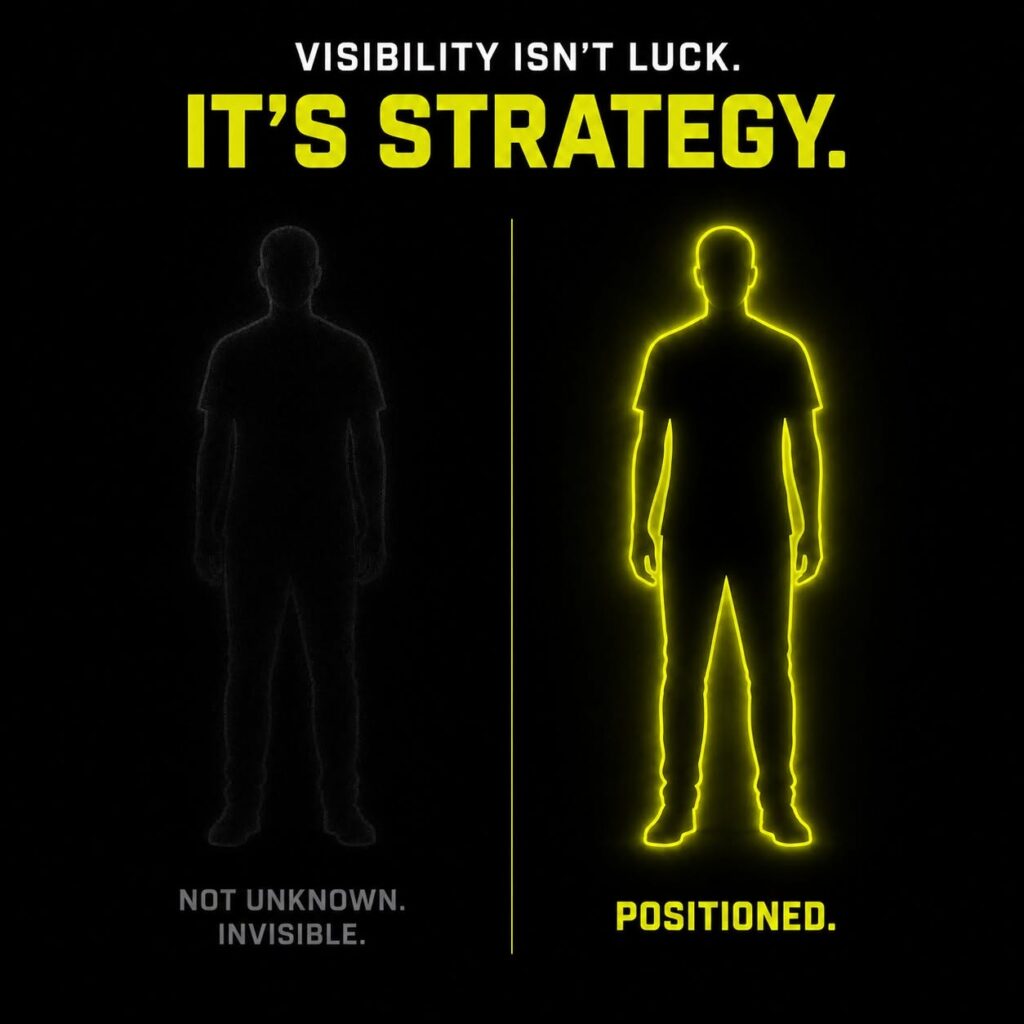
Every business owner has had this thought at some point: “If only more people knew about my business, I’d have more customers.” It sounds logical — after all, if more people see your business, surely more people will buy from you. That assumption has fueled millions of dollars in advertising spend, countless hours of social media content, and an endless cycle of chasing visibility.
Businesses post every day. They boost content, hire influencers, print flyers, sponsor events, pay for billboards, chase followers, celebrate impressions. And yet many of those same businesses still struggle to generate consistent customers. If visibility alone created growth, this wouldn’t happen.
The uncomfortable reality is that most businesses aren’t suffering from a lack of exposure. They’re suffering from something far more dangerous: they’re invisible. And invisible is very different from unknown. Understanding the difference could completely change the way you approach marketing.
Unknown vs. Invisible: Two Problems That Look the Same
At first glance these problems appear identical — both result in low sales, both create frustration, both leave business owners wondering why their marketing isn’t working. But beneath the surface, they’re completely different.
An unknown business simply hasn’t reached enough people. Very few people have encountered the brand. The solution is straightforward: increase distribution, reach more people, advertise more strategically, create more opportunities to be discovered.
An invisible business, however, has already been seen. People have visited the Instagram page, scrolled past the ad, landed on the website, heard someone mention the business, maybe even clicked “Follow.” But nothing happened. Nothing stayed with them. The interaction disappeared from memory almost immediately — not because the business lacked quality, but because it lacked distinction.
Unknown businesses need exposure. Invisible businesses need positioning.
Confusing these two problems is one of the costliest mistakes a business can make.
Why More Marketing Doesn't Always Mean More Customers
Imagine pouring water into a bucket with a hole at the bottom. The answer isn’t pouring faster — it’s fixing the hole. Yet that’s exactly how many businesses approach marketing. Sales are slow, so they increase the advertising budget. Engagement drops, so they post more often. Reach declines, so they boost another post. Every solution focuses on getting in front of more people; almost none focus on what happens after people actually arrive.
Marketing doesn’t automatically create demand. Marketing amplifies whatever already exists. If your brand is memorable, marketing introduces more people to something worth remembering. If your brand is forgettable, marketing simply introduces more people to something they’ll forget.
Advertising is an amplifier. Not a magician.
It cannot manufacture clarity where none exists. It cannot create trust without consistency. It cannot invent a unique identity for a business that hasn’t defined one. This is why two companies can spend exactly the same amount on advertising and experience completely different outcomes. One creates momentum. The other burns budget. The difference usually isn’t the platform — it’s the positioning.
The Expensive Illusion of Visibility
Digital marketing has made it easier than ever to reach people. For a relatively small budget, you can put your business in front of thousands of potential customers. That sounds like incredible progress — but reach is not the same as impact.
Every day, the average person scrolls through hundreds of pieces of content — advertisements, videos, photos, stories, emails, notifications, promotions. Your business isn’t competing against your direct competitors alone. It’s competing against everything else demanding attention. The human brain has adapted to survive this overload: it filters, it ignores, it forgets. Only the messages that feel relevant, different, emotional, or useful manage to survive that filter. Everything else disappears.
This is why simply increasing impressions rarely solves deeper marketing problems. You aren’t just competing to be seen. You’re competing to be remembered. And memory is earned, not purchased.
Why People Forget Most Businesses
Think back to yesterday. How many advertisements did you see? Probably dozens, maybe hundreds. Now try remembering five of them. It’s surprisingly difficult — not because those advertisements never reached you, but because they failed to create a meaningful impression.
Human beings don’t remember information simply because they encounter it. They remember information that connects with something already important to them. A message sticks when it answers a question, solves a problem, challenges an assumption, creates curiosity, or reinforces an existing belief. Generic messages accomplish none of these. “We offer quality services.” “Customer satisfaction is our priority.” “We deliver excellence.” “Affordable prices.” How many businesses could honestly say the same thing? Thousands. Maybe millions.
When everyone sounds identical, nobody becomes memorable. Customers aren’t trying to remember every business they encounter — they’re trying to remember the businesses that make their decision easier. That only happens when a business gives people something specific to remember.
Positioning Is More Than a Tagline
When people hear the word “positioning,” they often think about slogans, taglines, or mission statements. Positioning is much deeper than that. Positioning is the mental space your business occupies in the customer’s mind — what people immediately think about when they hear your name, the story they tell themselves about what makes your business different, the shortcut their brain creates.
When someone asks, “Who specializes in Meta advertising for service businesses?” you want your name to appear instantly. That’s positioning. The strongest brands don’t spend all their energy trying to become famous — they work relentlessly to become associated with one clear idea. That association is worth more than endless visibility.
Every Brand Is Sending Signals
Whether you realize it or not, your business is communicating constantly — every caption, design, advertisement, customer interaction, testimonial, pricing decision, email, and word on your website sends a signal. Over time, those signals accumulate and eventually form an identity.
The problem is that many businesses never intentionally shape those signals. One week they’re trying to sound luxurious; the next they’re competing on affordability; the following week they’re chasing humor because another brand went viral. The message changes, the identity changes, customers become confused, and consistency disappears. Strong brands don’t become memorable because they’re constantly changing — they become memorable because they’re consistently recognizable.
The Nigerian Business Trap
Spend a few minutes browsing social media and you’ll notice something fascinating: hundreds of businesses look almost identical. The bios say “Quality products and services,” “Customer satisfaction guaranteed,” “Affordable prices,” “Your trusted partner.” Then the content begins — Monday motivation, Tuesday product picture, Wednesday quote, Thursday flyer, Friday discount, Saturday “Happy Weekend.” Repeat.
None of it is necessarily bad. But none of it answers the customer’s most important question: why should I remember you instead of everyone else? Most businesses never answer that question. Instead, they assume consistency alone creates memorability. It doesn’t. Posting every day with a generic message simply creates more opportunities for people to ignore you. Frequency cannot replace clarity.
Why Generic Businesses Become Background Noise
Imagine walking through a busy airport. Announcements happen constantly, and most people barely notice them — not because the speakers are broken, but because their brains have decided those announcements aren’t personally relevant. Now imagine hearing your own name over the speaker. Everything changes instantly. Why? Specificity. Your brain immediately recognizes relevance.
Marketing works the same way. Generic businesses become background noise because they speak to everyone. Businesses with clear positioning feel personal because they speak directly to someone. The difference isn’t volume — it’s precision. When customers feel like a message was written specifically for them, they stop scrolling. They pay attention. They remember. That’s where effective marketing begins — not with louder advertising, but with clearer positioning.
Specificity Is What Makes You Memorable
If there is one word that separates memorable businesses from forgettable ones, it is this: specificity. Specific businesses are easy to understand. Generic businesses force customers to think — and people don’t like thinking when they’re making everyday buying decisions.
The human brain is constantly looking for shortcuts. When it encounters a business, it asks a series of questions almost instantly: Who is this for? What problem do they solve? Why are they different? Why should I trust them? If your brand answers those questions quickly, you become easier to remember. If it doesn’t, your audience moves on.
This is why businesses that try to appeal to everyone usually appeal strongly to no one. The fear is understandable — many business owners believe narrowing their message means turning customers away. In reality, the opposite happens. The clearer you become about who you serve, the easier it becomes for the right people to recognize themselves in your message. Specificity doesn’t shrink your market. It sharpens your relevance. And relevance is what creates attention.
The Most Memorable Brands Stand For Something
Think about the brands you admire most — global or small local businesses, chances are they have something in common: a clear point of view. They believe something, challenge something, stand against something. They aren’t afraid to make their perspective known. People don’t remember businesses because they’re neutral; they remember businesses because they communicate ideas worth remembering.
This doesn’t mean creating unnecessary controversy — it means having convictions. A business with no point of view becomes interchangeable. A business with a clear philosophy becomes recognizable.
You Cannot Be Remembered for Everything
One of the biggest mistakes businesses make is trying to own too many ideas — quality, affordability, speed, luxury, innovation, customer service, reliability. Eventually, none of those words mean anything. The strongest brands usually own one central idea, and everything else supports it.
When people hear Volvo, many think of safety. When they hear FedEx, they think of delivery. When they hear Nike, they think of performance. Those companies certainly offer more than one thing, but they understand that memory requires focus. The same principle applies to small businesses. Ask yourself: if someone could remember only one thing about your business, what should it be? If you don’t have an answer, neither will your customers.
Why Positioning Makes Advertising Cheaper
Most people think advertising success depends primarily on budget. Budget matters, but clarity matters more. Imagine two businesses advertising identical services. The first says, “We provide high-quality digital solutions for businesses.” The second says, “We help service businesses generate qualified leads using strategic Meta advertising.” Which one is easier to understand? Which one immediately attracts the right audience and filters out people who aren’t a good fit?
Clear positioning improves every part of your advertising: stronger headlines, more precise targeting, more relevant messaging, easier landing pages, shorter sales conversations, better conversion rates. Positioning doesn’t just improve branding — it improves efficiency. Every naira spent on advertising works harder because the message is clearer. Businesses often try to solve expensive marketing problems with bigger budgets, when many of those problems disappear once positioning improves.
The Cost of Being Forgettable
Most business owners calculate marketing costs incorrectly — they think only about the money they spend. Few think about the opportunities they lose. Every day someone is actively searching for the solution you provide: asking for recommendations in a WhatsApp group, comparing service providers, visiting three different websites, saving two Instagram pages, making a buying decision.
If your business leaves no lasting impression, you quietly disappear from consideration — not because your service wasn’t good enough, not because your pricing was unreasonable, not because your competitors were dramatically better. Simply because your brand wasn’t memorable enough to return to mind when it mattered. Businesses rarely fail because nobody ever heard about them. Many fail because people heard about them once, and never thought about them again.
Positioning Before Promotion
Many businesses reverse the correct order. They begin with promotion; only later do they think about positioning. That creates unnecessary frustration. Imagine building a house — you wouldn’t paint the walls before laying the foundation. Yet businesses often spend thousands promoting messages they haven’t clearly defined.
Positioning comes first. Promotion comes second.
Brand identity supports both. Once those pieces align, advertising becomes an accelerator instead of a rescue plan. This is why businesses sometimes experience disappointing advertising results — the advertisements weren’t necessarily poor; the foundation underneath them wasn’t strong enough. Marketing cannot consistently outperform positioning. Eventually every campaign reaches the same ceiling, and that ceiling isn’t created by the platform. It’s created by the brand.
A Simple Positioning Exercise
Imagine someone asks your ideal customer, “What does this business actually do?” What answer would you hope they give? Now compare that answer with your website, your Instagram bio, your LinkedIn headline, your advertisements, and your homepage. Do they all communicate the same idea, or do they each tell a slightly different story? Consistency creates recognition. Recognition creates familiarity. Familiarity builds trust. And trust drives buying decisions.
The Businesses That Win Are Usually the Clearest
There’s a comforting myth in business: that the best product always wins. Unfortunately, markets don’t work that way. The clearest business often beats the better business, because customers cannot evaluate quality they don’t understand. They buy based on perception long before they experience reality.
That doesn’t mean quality isn’t important — quality keeps customers. Positioning earns the opportunity to serve them in the first place. Without attention, your excellence remains hidden. Without clarity, your expertise remains invisible. Without positioning, your marketing budget spends its time explaining instead of persuading.
Visibility Without Identity Is Temporary
Many businesses experience short bursts of attention — a viral post, a successful campaign, an influencer mention. Traffic increases, followers grow, messages arrive. Then everything slows down again. Why? Because attention is temporary. Identity is lasting.
Visibility introduces people to your business. Identity gives them a reason to remember it. One creates awareness, the other creates preference. Businesses chasing visibility alone constantly need another campaign, another trend, another viral moment. Businesses with strong identities accumulate recognition over time — every interaction reinforces the same message, and eventually the market begins repeating it for them. That’s when branding becomes an asset instead of an expense.
Becoming the Obvious Choice
Every business owner wants more leads. Fewer people ask the better question: “Why should someone choose us immediately instead of comparing five competitors?” That’s what positioning ultimately answers. The goal isn’t simply to become known — it’s to become obvious. When someone needs your service, your name should arrive naturally in their mind, not because you’ve interrupted them with countless advertisements, but because you’ve consistently communicated one clear idea over time.
Final Thoughts
Your business probably doesn’t need more visibility. It needs more meaning. Marketing isn’t a competition to shout the loudest — it’s a competition to become the clearest. People don’t remember businesses that try to say everything. They remember businesses that consistently stand for one meaningful idea.
So before increasing your advertising budget, before posting more frequently, before chasing another marketing trend, ask yourself a different question: if someone encounters my business today, what exactly will they remember tomorrow? If the answer isn’t immediately obvious, that’s where the real work begins — not with another advertisement, not with another social media post, but with positioning.
There’s a world of difference between a business people notice and a business people remember.
Ready To Build A Brand People Remember?
Marketing should do more than increase visibility — it should create recognition, trust, and preference. We help businesses build a strong identity before scaling with strategic Meta advertising.
Strong Identity. Smart Ads. Real Growth.