
Stop Obsessing Over Targeting: Why Meta Ads Are Won By Creative, Not Interests
Meta’s ad delivery system has quietly become better at finding your customer than your audience settings ever were. Here’s what that means for how you should actually run campaigns.
Meta Ads Mechanics · Creative Strategy · 9 min read
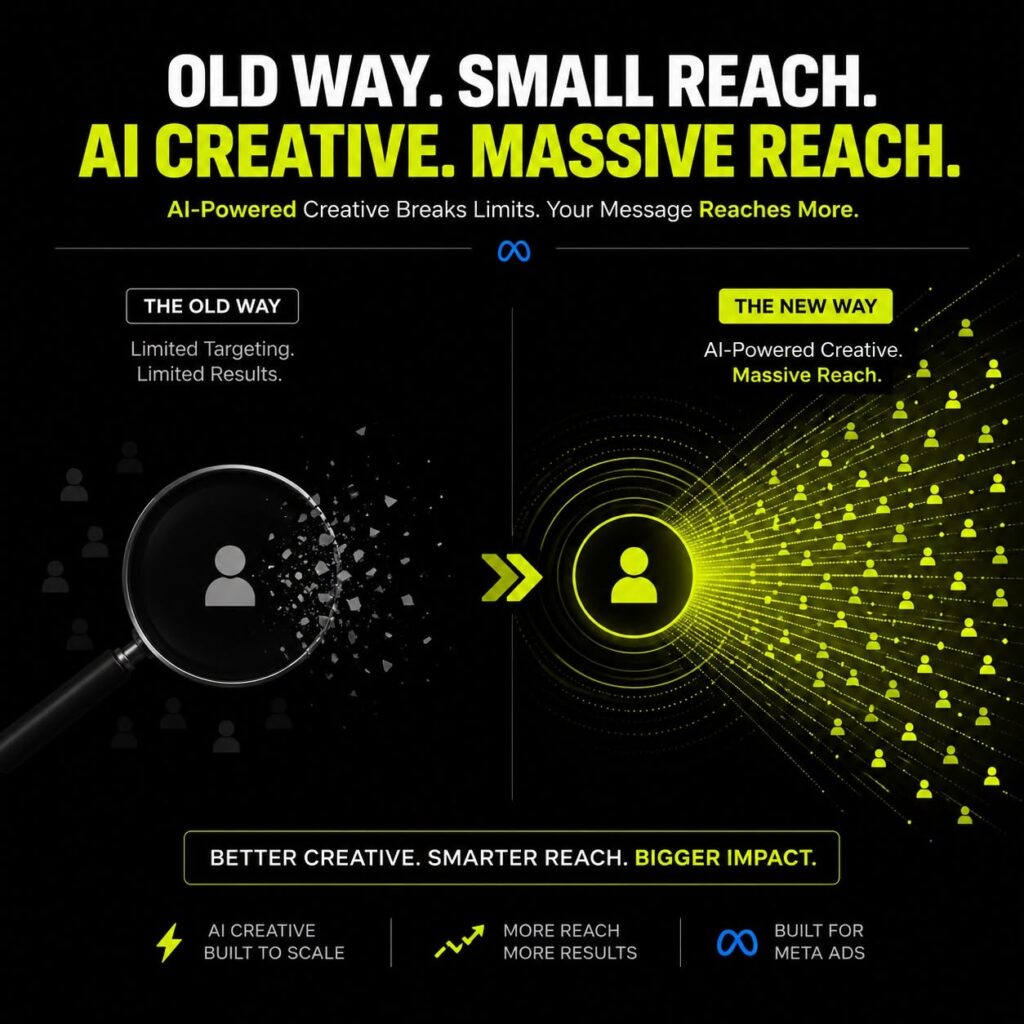
For years, running Meta ads meant playing a precision game. Business owners would spend hours building the “perfect” audience — stacking interests, narrowing demographics, excluding overlapping groups, duplicating campaigns into a dozen ad sets. If a campaign underperformed, the instinct was always the same: the targeting must be wrong.
That instinct made sense a few years ago. Today, it’s usually the wrong diagnosis — and chasing it is quietly costing advertisers money.
The Era Of Manual Targeting
Not long ago, audience-building was the job. Advertisers stacked twenty interests, split campaigns by age and gender, built dozens of lookalikes, and excluded every possible overlap — all on the belief that if you could define the perfect audience before launch, performance would follow.
That approach worked because Meta’s system genuinely depended on the inputs advertisers gave it. The platform needed guidance, and targeting was the lever that provided it. But the platform has changed a great deal since then.
What Actually Changed
Meta’s delivery system no longer relies primarily on the interests you select. It now weighs a much wider set of signals before deciding who sees your ad — your creative, your copy, your landing page, your past conversions, and the behavioral patterns tied to your Pixel data. Every interaction becomes another signal the system can learn from.
Your audience settings are no longer the whole strategy. They’re one signal among many — often not even the strongest one.
Meet Andromeda: The Engine Behind The Shift
Much of this shift traces back to Andromeda, Meta’s AI-powered ads retrieval engine, first detailed publicly by Meta’s engineering team in December 2024. Rather than starting from the audience you define, Andromeda evaluates the ad itself — its creative, its engagement patterns, and its predicted relevance — to decide who is likely to respond, even when that person doesn’t perfectly match your selected interests.
In practical terms: your audience settings are no longer the entire strategy. They’re one signal among several, and frequently not the strongest one in the mix.
Why “Perfect Targeting” Can Quietly Hurt Performance
Here’s where a lot of well-intentioned campaigns fall apart. Imagine you sell premium office furniture. Instead of one campaign with broad targeting and several creative angles, you build separate ad sets for entrepreneurs, CEOs, interior design enthusiasts, architecture lovers, coworking-space users, and startup founders.
It feels thorough. It feels strategic. But what actually happens is your budget gets split across several isolated learning environments — and most of those audiences overlap anyway. Each ad set gets less data, takes longer to exit the learning phase, and quietly competes with the others for the same people.
Splitting one offer across many narrow ad sets doesn’t make delivery more precise — it fragments your budget and slows down the very learning process you’re trying to speed up. Fewer, broader ad sets with more creative variation almost always outperform a dozen narrow ones chasing the same audience.
The Real Job Of Targeting Today
Targeting still matters — just not as the steering wheel. Today it works more like a guardrail: keeping delivery within sensible boundaries (your country, your language, your minimum age) rather than manually hand-picking every future customer. Beyond those basic guardrails, tighter and tighter targeting usually produces diminishing returns, because human behavior rarely fits neatly inside the interests listed on a profile.
Why Creative Has Become The New Targeting
This is the mindset shift that matters most: creative isn’t just persuasion anymore — creative is targeting. A well-made ad naturally attracts the people it’s meant for. Its visuals, wording, and the problem it describes act as a filter: the wrong people scroll past, and the right ones pause, click, and engage. Those behavioral signals are exactly what the delivery system uses to find more people like them.
Creative isn’t just persuasion anymore. Creative is targeting.
Test Creative, Not Just Audiences
If audience testing used to be the default experiment, creative testing is the smarter one today. Instead of ten audiences running one ad, try one broad audience running several creative approaches — different headlines, hooks, opening lines, offers, testimonials, and calls-to-action. Every variation teaches the system something new about who responds, and that data compounds into lower acquisition costs over time.
The Hidden Hero: Your Pixel
None of this works without accurate conversion data. Your Pixel tells Meta what actually happens after someone clicks — whether they viewed a product, started checkout, purchased, or submitted a lead. Without that signal, the algorithm is optimizing half-blind, no matter how good your creative is. A surprising number of underperforming accounts trace back to broken or incomplete tracking rather than bad targeting or weak creative.
If you’re not sure which of the three is actually holding your account back — targeting, creative, or tracking — that’s exactly what a marketing audit is built to answer.
Meta’s delivery system has become better at finding your customer than manual targeting ever could. Your job isn’t to micromanage who sees the ad — it’s to give the algorithm the strongest possible inputs: a clear offer, strong creative, and clean conversion data.
Action Steps
- Simplify your account — fewer, broader ad sets instead of dozens of narrow ones.
- Redirect the time you'd spend refining interests into producing more creative variations.
- Confirm your Pixel and conversion tracking are actually firing correctly.
- Use targeting as a guardrail (location, language, age) — not a precision instrument.
- Review performance by creative angle, not just by audience.
This shift is one piece of a larger picture — it maps closely onto the Attract and Convert stages of the V12 Growth Engine™, where creative and structure carry far more weight than manual audience-building ever did.
Meta Engineering, “Meta Andromeda: Supercharging Advantage+ Automation,” December 2024.
Not Sure If It's Targeting, Creative, Or Tracking?
A short strategy call is usually enough to tell you exactly where your account’s real bottleneck is.